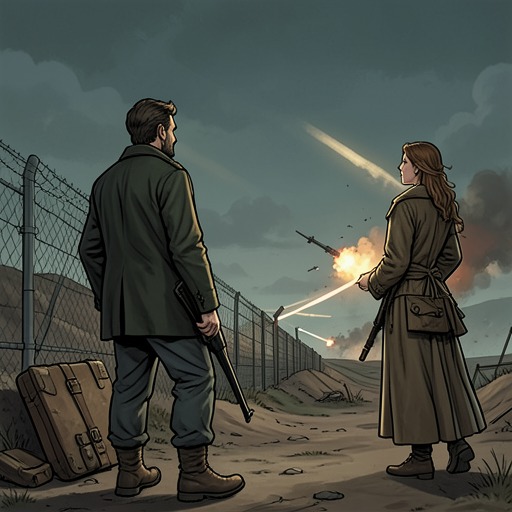
Karl Riemeck’s failed escape and shooting
The Spy Who Came in from the ColdKarl Riemeck’s failed escape and shooting turns an apparent crossing into a public killing, and the moment when Alec Leamas watches him fall becomes the defining loss of Leamas’s Berlin operation. Riemeck seems to have cleared the checks and to be approaching the line when searchlights expose him; an East German sentry shoots him before he can reach safety. His death leaves Leamas without an agent of value, while the intelligence Riemeck had supplied and the question of whether he had help continue to animate the later investigation.
The crossing and the shooting
The scene begins with an urgent summons to the observation window. A younger policeman whispers that a man with a bicycle has appeared. Leamas takes up the binoculars and recognizes Riemeck, who is wearing an old Wehrmacht macintosh and pushing his bicycle. From his vantage point, Leamas follows what looks like a successful passage through the document check: Riemeck leans the bicycle against the railing, walks casually to the Customs hut, then emerges and waves cheerfully to the man at the barrier. The red-and-white pole rises. To Leamas, Riemeck has made it through; only the sentry, the line, and safety remain.
The apparent success collapses in an instant. Riemeck seems to hear or sense danger, looks back, and pedals furiously, bent low over the handlebars. A sentry on the bridge turns to watch him. Searchlights blaze on, pinning Riemeck in their beam; a siren wails and orders are shouted. Inside the observation point, the two policemen drop to their knees behind sandbagged slits and ready their automatic rifles. The firing comes from the East German sentry, who shoots into his own sector, away from the men watching through the window.
Riemeck is still moving after the first shots. One seems to thrust him forward, the next to pull him back; he passes the sentry on his bicycle while the sentry continues to fire. Then he sags and rolls to the ground. The observers hear the bicycle clatter as it falls. The action’s narrow geography sharpens its cruelty: Riemeck has passed one barrier and is only a short distance from the line, yet the last stretch is enough to turn escape into death.
Leamas as witness
For Leamas, the crossing is not an abstract report but a sequence watched in real time. His inward conviction that Riemeck must have made it gives way to the sight of the searchlights, the shots, and the fallen bicycle. He hopes that Riemeck is dead, a grim response to the prospect that a badly wounded agent might otherwise be captured. Later, Leamas tells another character that Riemeck was shot and that he should be dead by then; he stresses that Riemeck nearly made it and had hurried when the Abteilung’s men had reached the checkpoint just after he was allowed through. A sentry shot him twenty yards short of the line. The brief account confirms the immediate outcome while retaining the shock of the watched scene.
That witness position also establishes the asymmetry between operational knowledge and control. Leamas can see the barrier, the sentry, and the consequences of the escape attempt, but he cannot intervene. His work has depended on managing agents and routes; here, the decisive action takes place before him, beyond his power to reverse. The scene makes his professional failure visible as a personal experience of watching a colleague and agent move from apparent safety to mortal danger.
The loss of the Berlin network
Riemeck’s death is the culmination of a wider collapse. Before the escape attempt, Leamas’s network has already been hit repeatedly: a girl used for courier work is shot dead as she leaves a West Berlin cinema; a discarded agent from Peter Guillam’s network is found dead and mutilated beside a railway track; and two members of another network under Leamas’s control are arrested and sentenced to death. Leamas first treats the girl’s killing as possibly unrelated to her work, but the later deaths make coincidence untenable. By the time Riemeck is caught, the pattern has become remorseless.
The narrative states the result starkly: Leamas leaves Berlin as he came, without a single agent worth a farthing; Mundt has won. Riemeck’s failed crossing therefore marks both an individual death and the practical destruction of the network Leamas had been responsible for. The loss gives the subsequent operation its apparent rationale: Leamas is left with a history of failure and with knowledge that can be used to make his fall seem credible. Yet the opening scene also sets a human cost against the later calculations. For the service, the network is an operational asset; for Leamas, Riemeck is the man whose escape he watched fail.
Intelligence, suspicion, and the later operation
Riemeck’s death does not erase the value of what he had passed. Material associated with him includes minutes of the Praesidium’s last meeting, a draft revision concerning East Germany’s relationship to COMECON, and a breakdown of the East German Intelligence Service, listing departmental functions and personalities. When Peters questions whether all this intelligence could have come from Riemeck alone, Leamas answers that Riemeck had seen enough. Peters remains doubtful: Riemeck must have had help. The question persists for Leamas, who recalls that Control had also asked about Riemeck’s access and wonders whether a high-level collaborator was involved in what Riemeck and that person obtained together.
That uncertainty becomes relevant to Operation Rolling Stone. Fiedler argues that the intelligence Leamas has provided is not sufficient to justify the operation’s price; the puzzle is not merely what Leamas knows, but whether the clues point to a spy at a higher level. Later, Fiedler lays out bank evidence connecting Leamas’s deposits in Copenhagen and Helsinki with Mundt’s clandestine journeys. The details include a ten-thousand-dollar Copenhagen deposit, drawn by a co-signatory one week after it was made, and the coincidence between that withdrawal and Mundt’s visit to Denmark. The eventual revelation that Leamas has been deceived changes how the reader understands the operation and the evidence built around it, but it does not resolve the earlier question of how much Riemeck could have obtained by himself. His death is thus both the concrete loss that starts Leamas’s fall and a continuing gap in the intelligence picture.
The Wall and the event’s significance
The shooting occurs within the novel’s divided Berlin, where border procedures, armed guards, searchlights, and observation posts determine whether a crossing is possible. The wider setting is described as a new and increasingly fortified boundary, marked by obstacles, towers, and barbed wire. At Checkpoint Charlie, American and Soviet Bloc tanks face each other across a narrow strip of road, while intelligence networks that had not anticipated the Wall must adapt to a more clandestine and perilous environment. Such circumstances give Riemeck’s attempted escape its immediate physical danger and place it within a wider crisis in which movement and information are controlled across the same divide.
The retrospective account of the Wall emphasizes that it became not only a physical barrier but also a symbol of ideology’s violence, and that the new border made espionage more secretive and dangerous. Riemeck’s crossing gives that historical frame a specific human cost: he passes the checks, reaches the road, and is still shot short of the line. The scene does not present escape as a clean passage from danger to safety. It makes the border’s power most visible at the instant when freedom seems almost attained, and leaves Leamas—and the reader—with the sound of the bicycle falling.